Baseline: Temple Recession Established
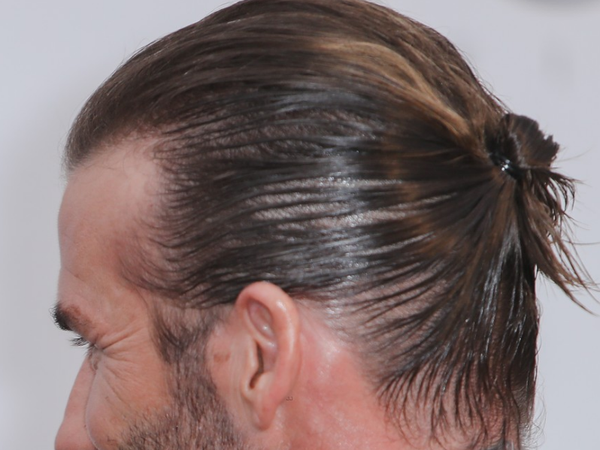
Images from 2012 show noticeable recession at the frontal corners. The hairline appears higher at the temples, and density is thinner near the lateral edges compared to the central forelock.
A detailed before and after analysis of David Beckham’s hairline explores whether visible improvements in frontal density between 2012 and 2025 suggest a possible hair transplant. Based solely on dated public images, this breakdown focuses on hairline shape, temple recession, and long-term density consistency.
Key details from the dossier.
Observations based on public appearances. Not medically confirmed.
The following timeline compares before and after moments across verified public appearances. Early images from 2012 establish a baseline with visible temple recession and mild frontal thinning. Later appearances, particularly from 2018 onward show a more structured and stabilized hairline.
By placing these images side by side chronologically, we can observe whether the progression reflects natural aging, styling influence, or a potential density intervention. This analysis remains strictly observational and is not a medical assessment.
A visual timeline based on public appearances over time.
Images from 2012 show noticeable recession at the frontal corners. The hairline appears higher at the temples, and density is thinner near the lateral edges compared to the central forelock.
The slicked-back hairstyle in these images fully exposes the hairline architecture. With the hair pulled tightly away from the forehead, temple recession becomes clearly visible on both sides. The lateral corners show measurable depth, forming a mature “M-shaped” pattern typical of mid-stage male pattern hair loss.
Density across the central forelock appears stronger than the temples, creating contrast between the midline and recessed corners. There is no visible lowering of the frontal hairline compared to earlier baseline years. In fact, the pulled-back style emphasizes the structural recession rather than concealing it.
No evidence of density reinforcement or graft placement is visually apparent at this stage. The hairline shape appears natural, age-consistent, and unchanged in architecture.
In the 2017 image (short, closely cropped cut), temple recession remains clearly defined. The corners appear deep, and the frontal outline follows the same mature pattern seen in earlier years. The short length reduces contrast but does not alter the underlying hairline architecture.
By 2018, the hair is slightly longer and styled upward, allowing the frontal structure to be examined more clearly. While density appears somewhat fuller under stage lighting, the temple depth still resembles the established recession pattern. The lateral corners do not yet show convincing structural reinforcement.
Across these two years, the hairline appears stabilized rather than improved. If an intervention occurred, this period would represent either the late pre-procedure stage or an early, subtle growth phase not yet fully visible.

By 2019, the frontal hairline appears more compact and symmetrical compared to 2012–2017 imagery. Temple recession looks less pronounced, and density across the frontal third appears more evenly distributed.
Unlike previous years, this shift looks structural rather than purely styling-based. The corners appear reinforced, and the hairline no longer shows the same depth of recession seen earlier in the decade.
Under close-up photography, density remains consistent. Temple areas do not appear widened.
Multiple angles and strong lighting do not reveal further thinning. Frontal architecture remains intact.
The hairline appears structurally preserved compared to 2012. Density remains even, with minimal visible temple recession relative to the earlier baseline.